Replatformed a 40-year event rental leader so customers could finally find its 1,000+ products.
Company
A Rental Connection
Timeline
2025 -
2026
Role
Product Designer
Context
A Rental Connection has supplied Southern California events for more than 40 years. Tents, tables, flooring, lighting, catering equipment, custom fabrication. If an event needs it, they got it. New owners had just taken over, and they wanted a website that matched the company they bought: a full-service leader with a top-tier reputation. The existing Squarespace site didn't tell that story. It looked like a starter site, not a leader's. Their two core audiences, professional event planners and engaged couples, deserved better. I was brought in to refresh the look, but what I discovered was a content discovery problem.
Challenge
The company rents more than 1,000 products, but it was difficult to grasp this from the site. Navigation was a flat list of 11 categories with no search bar. Event planners said they couldn't find what they needed. The sales team had the same frustration, and they used the site every day to build client recommendations. Squarespace also couldn't support the e-commerce structure a catalog this size demands. The goal became twofold: make the full inventory easy to discover, and elevate the brand to match four decades of leadership.

Process
I recommended replatforming to Shopify and started with structure, not styling. I explored three navigation concepts: a searchable mega-menu with faceted filters, occasion-first browsing organized around what customers were planning, and a search-first experience anchored in the homepage hero. We mocked up each flow and tested with staff and trusted event planners. The mega-menu won. It showed the inventory's breadth at a glance. I then recategorized the entire catalog, moving from 11 flat categories to 41 sub-categories under 10 top-level groups, naming each through competitor research and SEO keywords, and migrated every product with enriched metadata.


Solution
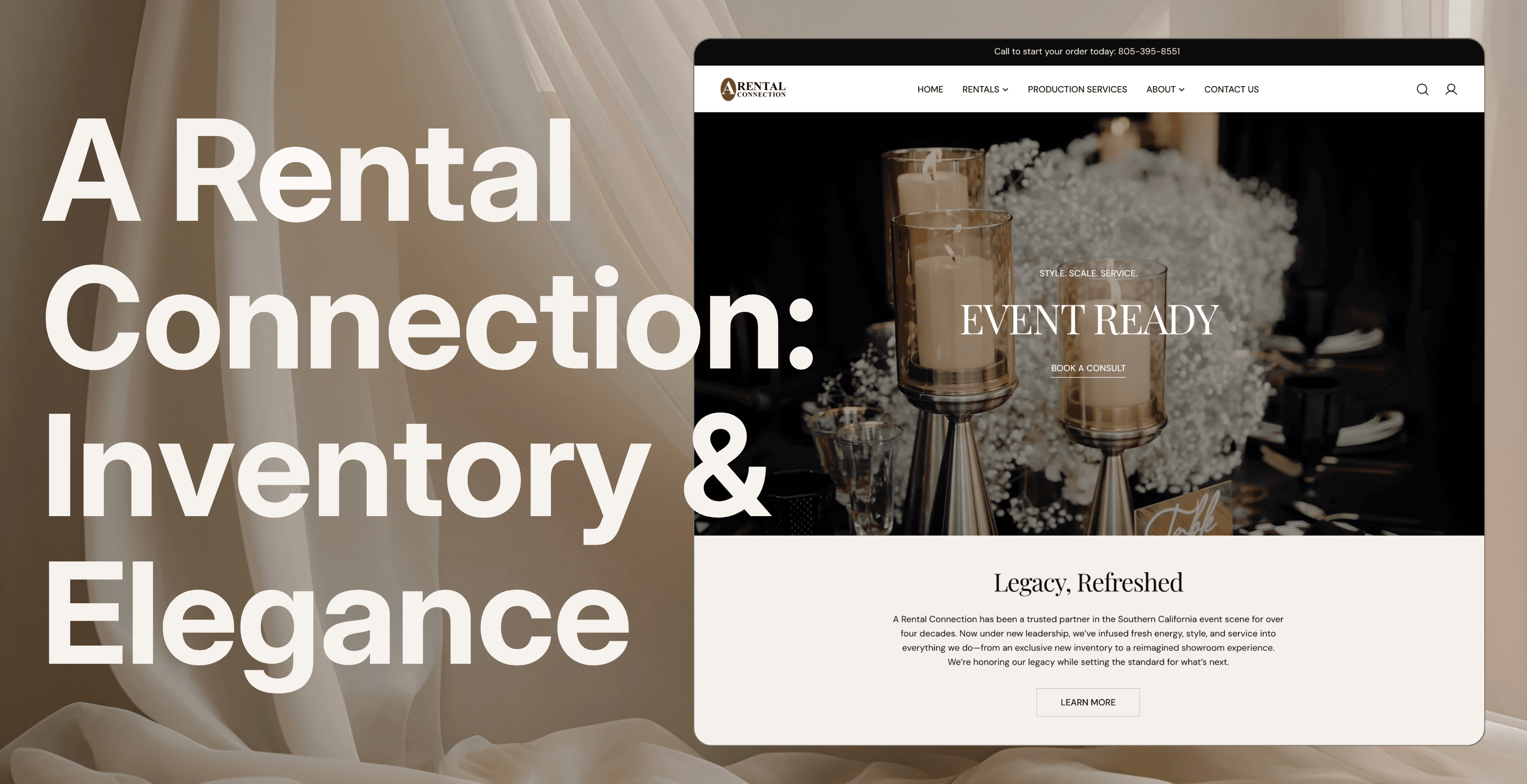
The new site is a Shopify storefront I built single-handedly, extending the platform with custom HTML where the editor fell short. A mega-menu presents the full catalog the moment you open it. A persistent search icon in the header opens a type-ahead drawer that suggests products and categories as you type. The website got a branding elevation too: black and a deep modern red set against warm neutrals, replacing a former blue, red, and white palette, with a modern serif paired with a clean sans serif for listings and body copy. I also wrote documentation so staff can add products without me.


Results
The redesign landed with the people who use the site most. The sales team can now find and recommend products quickly instead of digging through pages. Event planners can browse the full inventory or search straight to what they need. And the company finally has a storefront that looks like what it is: a 40-year leader in Southern California event rentals. The documentation I left behind means the team owns the catalog going forward. What started as a facelift ended as a foundation.
More projects


Replatformed a 40-year event rental leader so customers could finally find its 1,000+ products.
Company
A Rental Connection
Timeline
2025 -
2026
Role
Product Designer
Context
A Rental Connection has supplied Southern California events for more than 40 years. Tents, tables, flooring, lighting, catering equipment, custom fabrication. If an event needs it, they got it. New owners had just taken over, and they wanted a website that matched the company they bought: a full-service leader with a top-tier reputation. The existing Squarespace site didn't tell that story. It looked like a starter site, not a leader's. Their two core audiences, professional event planners and engaged couples, deserved better. I was brought in to refresh the look, but what I discovered was a content discovery problem.
Challenge
The company rents more than 1,000 products, but it was difficult to grasp this from the site. Navigation was a flat list of 11 categories with no search bar. Event planners said they couldn't find what they needed. The sales team had the same frustration, and they used the site every day to build client recommendations. Squarespace also couldn't support the e-commerce structure a catalog this size demands. The goal became twofold: make the full inventory easy to discover, and elevate the brand to match four decades of leadership.
Process
I recommended replatforming to Shopify and started with structure, not styling. I explored three navigation concepts: a searchable mega-menu with faceted filters, occasion-first browsing organized around what customers were planning, and a search-first experience anchored in the homepage hero. We mocked up each flow and tested with staff and trusted event planners. The mega-menu won. It showed the inventory's breadth at a glance. I then recategorized the entire catalog, moving from 11 flat categories to 41 sub-categories under 10 top-level groups, naming each through competitor research and SEO keywords, and migrated every product with enriched metadata.
Solution
The new site is a Shopify storefront I built single-handedly, extending the platform with custom HTML where the editor fell short. A mega-menu presents the full catalog the moment you open it. A persistent search icon in the header opens a type-ahead drawer that suggests products and categories as you type. The website got a branding elevation too: black and a deep modern red set against warm neutrals, replacing a former blue, red, and white palette, with a modern serif paired with a clean sans serif for listings and body copy. I also wrote documentation so staff can add products without me.
Results
The redesign landed with the people who use the site most. The sales team can now find and recommend products quickly instead of digging through pages. Event planners can browse the full inventory or search straight to what they need. And the company finally has a storefront that looks like what it is: a 40-year leader in Southern California event rentals. The documentation I left behind means the team owns the catalog going forward. What started as a facelift ended as a foundation.